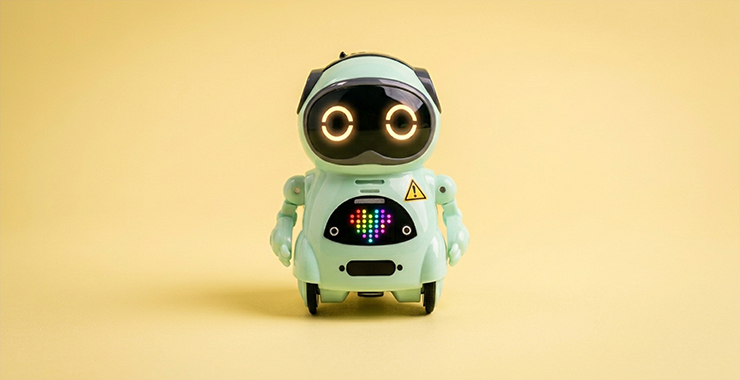
Concern has grown over the past year. In September 2025, Mitch Prinstein, PhD, then APA’s chief of psychology, testified before the U.S. Senate Judiciary Committee that it was “critical to sound an alarm regarding the use of AI chatbots within toys designed for infants and toddlers.” He cautioned that such products could disrupt the child-caregiver attachments on which early development depends.
In November 2025, Fairplay for Kids, a nonprofit focused on protecting children from exploitative digital marketing, released an advisory that called AI toys unsafe for children. That same month, the U.S. Public Interest Research Group (U.S. PIRG) Education Fund’s annual Trouble in Toyland report flagged similar dangers, from sexually explicit content to weak parental controls.
In January 2026, Common Sense Media, which evaluates the safety of digital media for children, rated AI toys an unacceptable risk for children younger than 6, particularly regarding emotional attachment and dependency. In May, the Australian Research Council’s (ARC) Centre of Excellence for the Digital Child released its Generative AI in Children’s Lives report, warning that AI toys could lead to “artificial intimacy,” “infinite chat,” and “emotional de-skilling,” even as they are presented to children as a “sentient, thinking, feeling, childhood friend.” And in May and June, the California and New York State Senates passed moratoriums on AI toys, though as of this article’s publication time, they had not yet been signed into law.
“Not only are young children’s language and emotional development tied to their interactions with adults, so are their immune system and neural development,” said Prinstein, now codirector of the Winston Center on Technology and Brain Development at the University of North Carolina at Chapel Hill. “We simply can’t afford for kids to spend less time with adults and more time with robots that are designed to keep them engaged as long as possible and extract their personal data.”
The speed of the AI toy market’s expansion is outpacing the science on these products. When researchers at the University of Cambridge’s Play in Education, Development, and Learning (PEDAL) Centre systematically reviewed the scientific literature for their 2026 report AI in the Early Years: Examining the Implications of GenAI Toys for Young Childrenopens in new window, they found only seven studies on generative AI toys for children younger than 5—and few examined how these toys affected young children’s development. In addition, there is not enough research yet on the long-term effects of these toys. “This is such a quickly moving field,” said Emily Goodacre, PhD, a developmental psychologist and coauthor of the study. “The research we’ve done—it’s the beginning. It’s the first step. The tech industry moves quickly. We want to move quickly, too.”
Kathy Hirsh-Pasek, PhD, a professor of psychology at Temple University and a senior fellow at the Brookings Institution and renowned for her work on early language, literacy, and play, offered a blunt assessment: “Right now, [AI toys] are a disaster and should not be on the market.” The reason, she said, is that children encounter these products at a fundamentally social stage of life. “If there was ever a time period when humans needed humans, it’s the 0 to 5 range,” Hirsh-Pasek said. “This is a time period of enormous brain growth, which happens because of back-and-forth, human-to-human interactions and conversations.” During those early years, children develop language, self-regulation, and core cognitive skills in the context of real relationships. They learn to communicate, manage their impulses, and build attention, memory, and flexibility.
AI toys can only simulate connection, Hirsh-Pasek warned. “They talk to you. They try to make you feel good. They tell you that they love you. They want to be your friend. They can’t be your friend,” she said. Even worse, Hirsh-Pasek added, they occupy “valuable space for real conversations and real imagination” that young children need in a socially rich environment.